
Indigoid Photoswitches
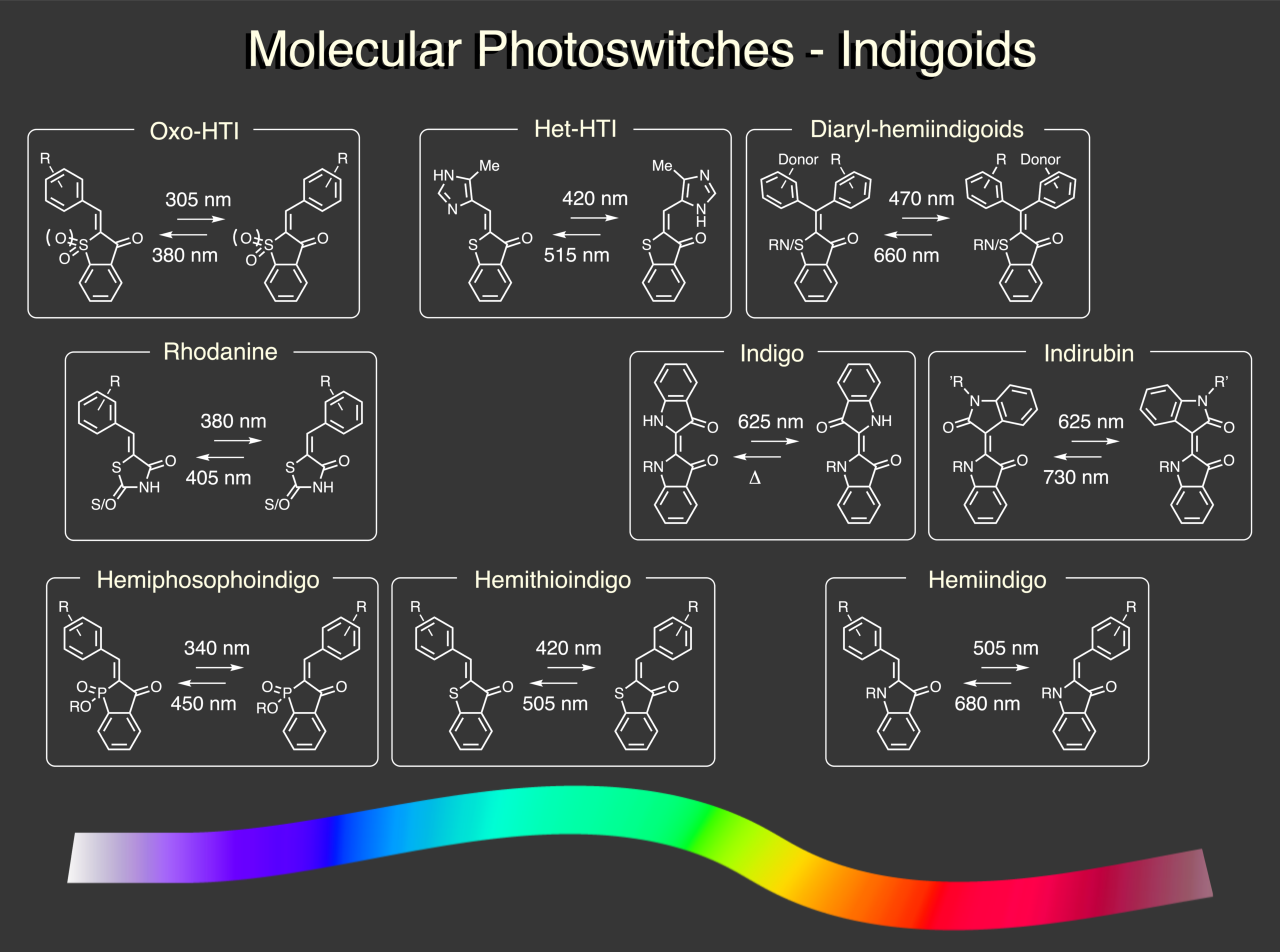
In a main research line we are developing new types of molecular photoswitches. Of particular importance are highly efficient bistable photoswitches with visible, red, and near infrared (NIR) light responsiveness, which are interesting for a variety of applications ranging from material sciences to biology and catalysis. Indigoids have been the main chromophore structures that we explored as photoswitches for many years. Excellent switching performance covering the whole visible spectrum are obtained for heterocyclic hemithioindigo (HTI),1 hemiindigo (HI)2,3 and their diaryl-variants (diaryl-HTI/diaryl-HI),4,5 as well as more recently for indirubine6 and hemiphosphoindigo (HPI).7
1 Angew. Chem. Int. Ed. 2022, 134, e202210855.
2 J. Am. Chem. Soc. 2017, 139, 15060.
3 J. Am. Chem. Soc. 2018, 140, 13558.
5 Nat. Commun. 2023, 14, 4382.
6 J. Am. Chem. Soc. 2021, 143, 18251.
7 Nat. Commun. 2025, 16, 1760.
Near Infrared Photoswitches
Near infrared (NIR) photoswitching is an emerging hot topic in the field of photochemistry. Moving photoresponsiveness into the NIR spectral realm offers unique opportunities for the development and applications of molecular photochromes. In particular, materials and biological applications benefit tremendously from NIR addressability, allowing for selective and non-damaging irradiation with deep penetration depth of the light into materials or tissues.
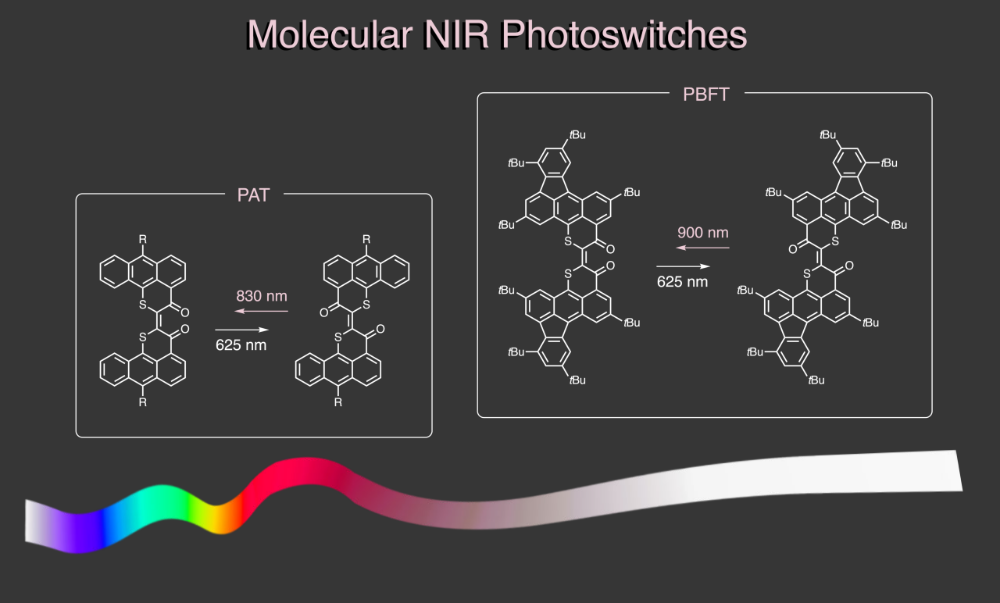
Our group has developed groundbreaking molecular photoswitches with excellent NIR responsiveness to drive double bond photoisomerizations. Our peri-thioindigoid scaffolds like peri-anthracenethioindigo (PAT)1 and peri-benzo[a]fluoranthenethioindigo (PBFT)2 allow direct excitation with up to 900 nm light, strong contrasting color changes. Using these outstanding performances of peri-thioindigoids, we could establish unique applications in materials and truly orthogonal and path-independent photoswitching. With PAT, four-color photoswitching in 2D materials could be shown. With PBFT, NIR-sensors and light-rewritable 2D and 3D displays could be established.
1 Angew. Chem. Int. Ed. 2023, e202312955.