
Molecular Motors
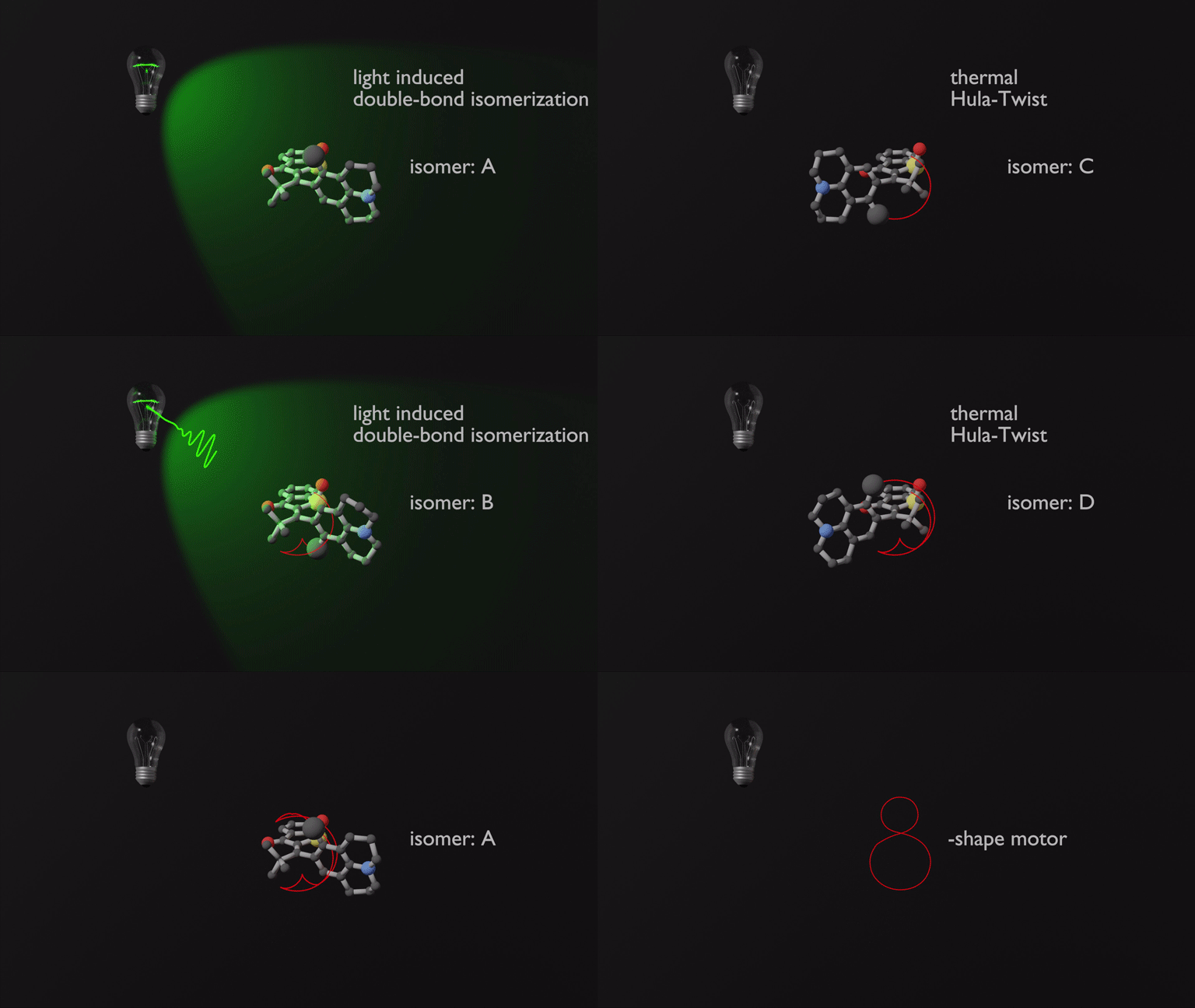
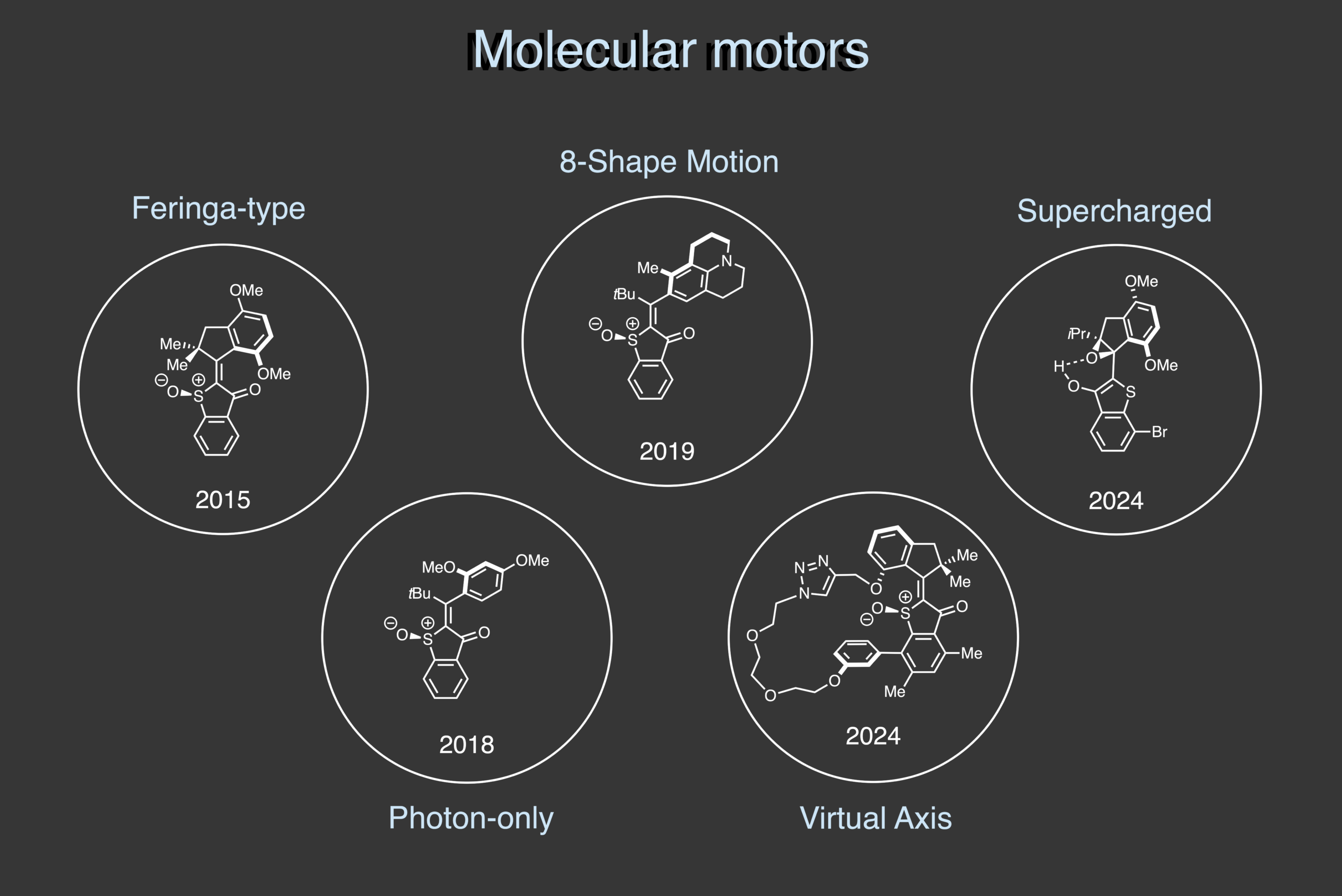
Molecular motors are archetypical molecular machines and provide directional motions in response to energy input. Our group has pioneered five different types of light-driven motors. They are all distinguished by unique motion mechanisms and are powered by visible or sunlight. Highlights include:
Fast rotating heterocyclic motors 1
The first photon-only motor working without thermal steps 2
A motor that provides a complex 8-shaped directional motion 3
A macrocyclic motor rotating around a virtual axis 4
A supercharged motor that harnesses a large amount of light energy 5
2 J. Am. Chem. Soc. 2018, 140, 16442.
3 Nat. Commun. 2019, 10, 4449.
4 J. Am. Chem. Soc. 2024, 146, 23387.
Integrated Molecular Machines
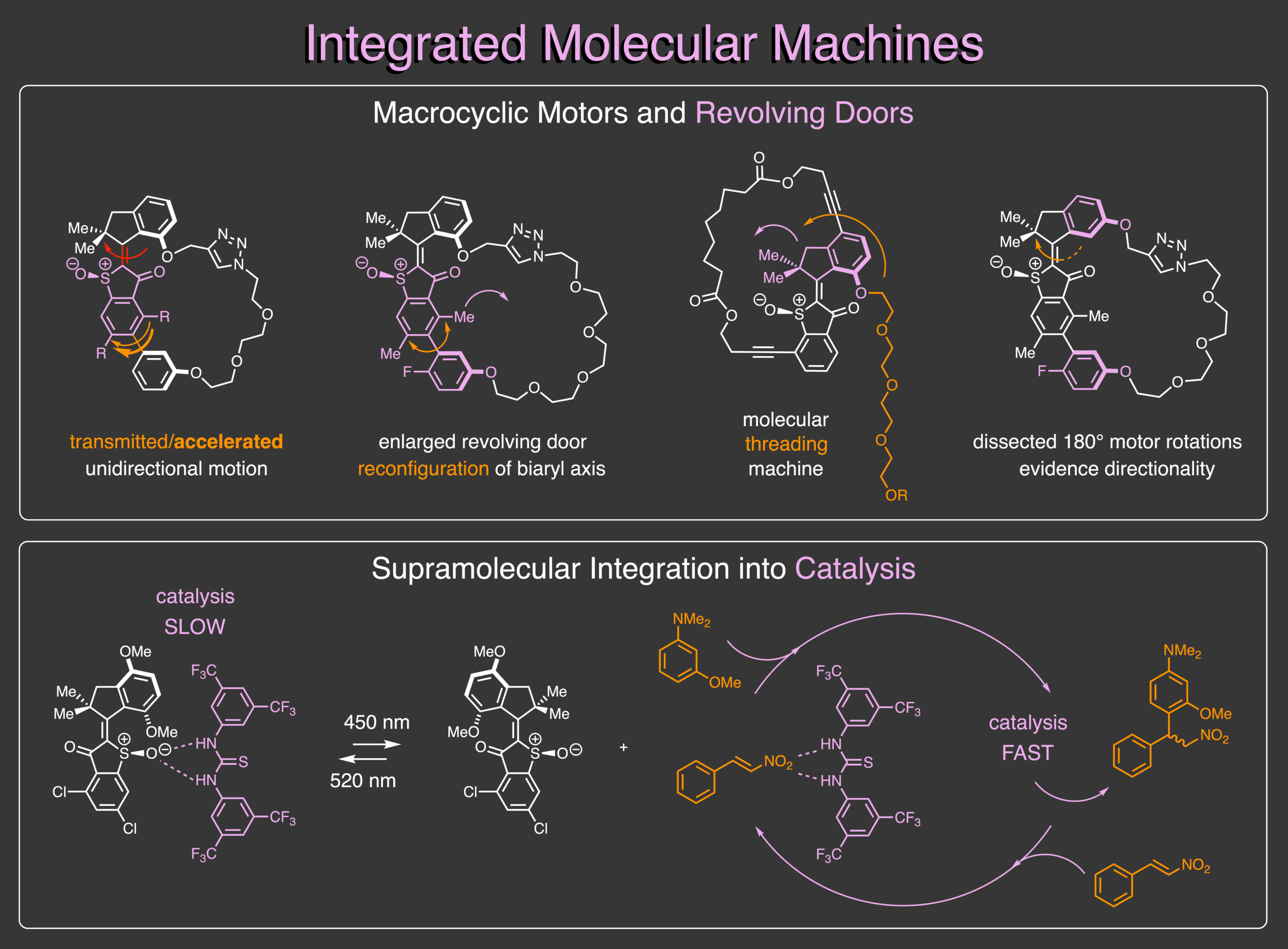
Integrated molecular machines build up capabilities by translating nanoscale motions and use them for actual tasks. In this area our group has brought forward a variety of concepts that explore molecular motors as driving units in complex settings. Using covalent macrocyclic approaches, motor motions can be translated1 and used for acceleration of remote single bonds2 or for deciphering motor directionality.3 Multi-configurable directional motions can be controlled in an enlarged macrocyclic setup opening up the possibility for customized machine operations.4
Another breakthrough is the realization of the worlds first molecular threading machine, which threads a nanoscale string through a macrocycle similar to macroscopic sewing and weaving processes.5
In a supramolecular and modular approach, a molecular motor is used in a relay-fashion to remote-control the efficiency of a catalysis reaction.6
1 Angew. Chem. Int. Ed. 2018, 130, 11231.
2 Angew. Chem. Int. Ed. 2020, 132, 5730.
3 Nat. Commun. 2023, 14, 4595.
4 J. Am. Chem. Soc. 2023, 145, 13081.
5 Angew. Chem. Int. Ed. 2022, 61, e202201882.
6 J. Am. Chem. Soc. 2020, 142, 19300.
Molecular Gears and Brakes
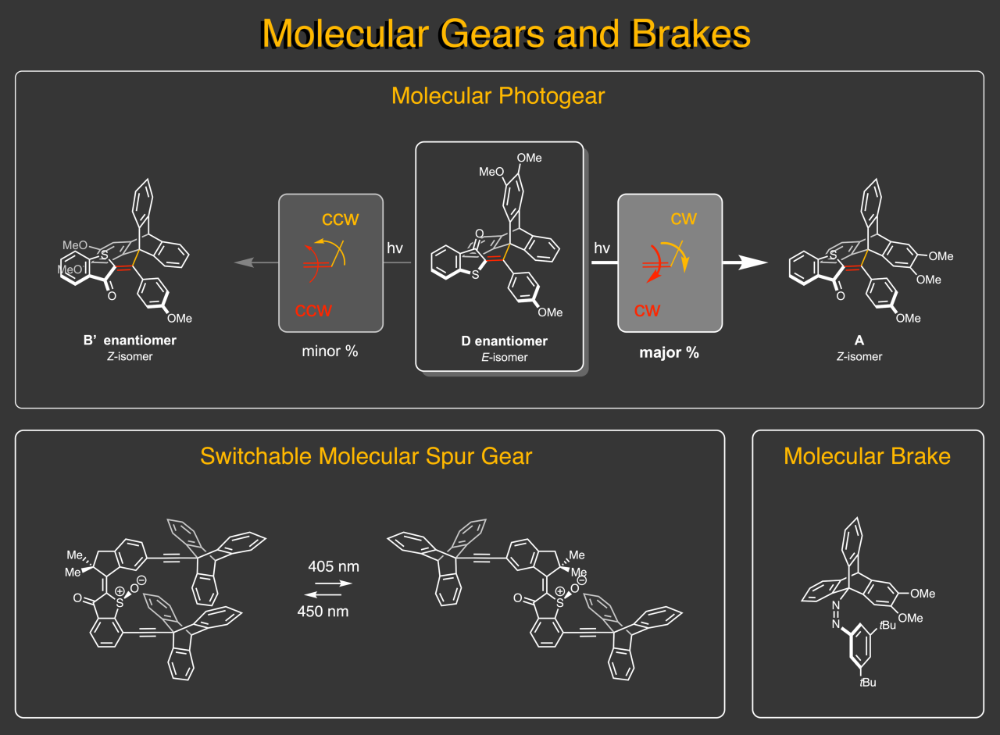
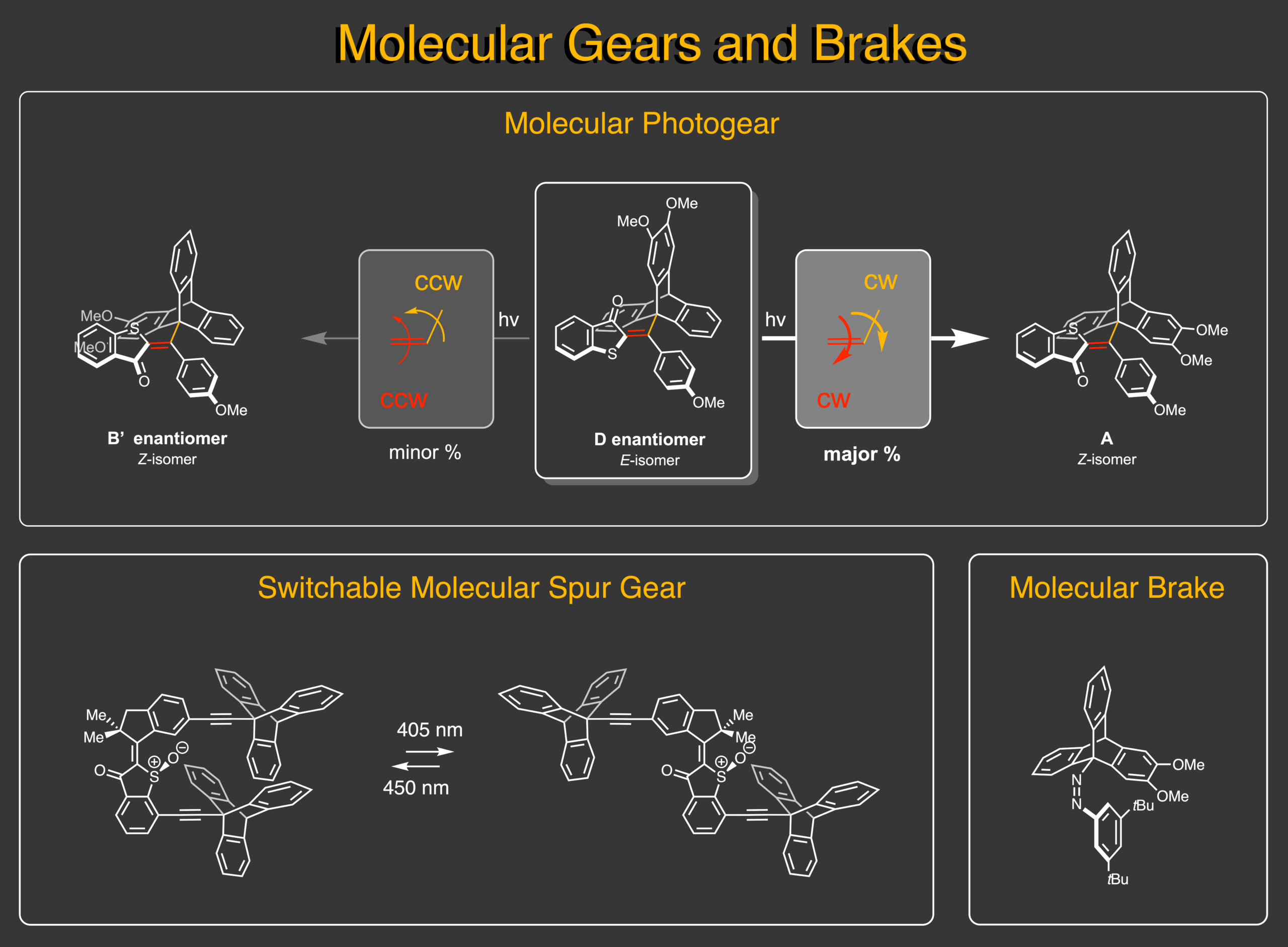
Gears and brakes represent early examples of molecular machinery and have been captured the imagination of researchers for many decades. However, the coupled motions of such molecular gearing systems were restricted to thermally activated modes of motions. They are thus temperature dependent and occur without directional control. Our group has presented the first light-powered molecular gearing system, which we termed photogear.1 Subsequently a directional bias was evidenced for the photogear, which opens up the possibility for constructing a novel piece of molecular machinery: a gearing motor.2 A fundamentally different setup for a gearing motor was developed later, in which three axes of rotation can potentially be controlled unidirectionally by integrating a motor moiety into a light-switchable molecular spur gear.3 The exploration of triptycene-azobenzenes hybrids allowed us to realize a light-switchable molecular brake system, in which the rotation speed of the triptycene propeller can be accelerated or decelerated by five orders of magnitude in rate.4
2 Angew. Chem. Int. Ed. 2024, 63, e202405299.