One core activity in our research concerns chromophore design and mechanistic studies to develop new photoresponsive molecules with unique property profiles. Our long-term goal is gaining absolute control over light-induced molecular motions enabling full spatial and temporal resolution of nano-, micro-, and macroscopic properties.
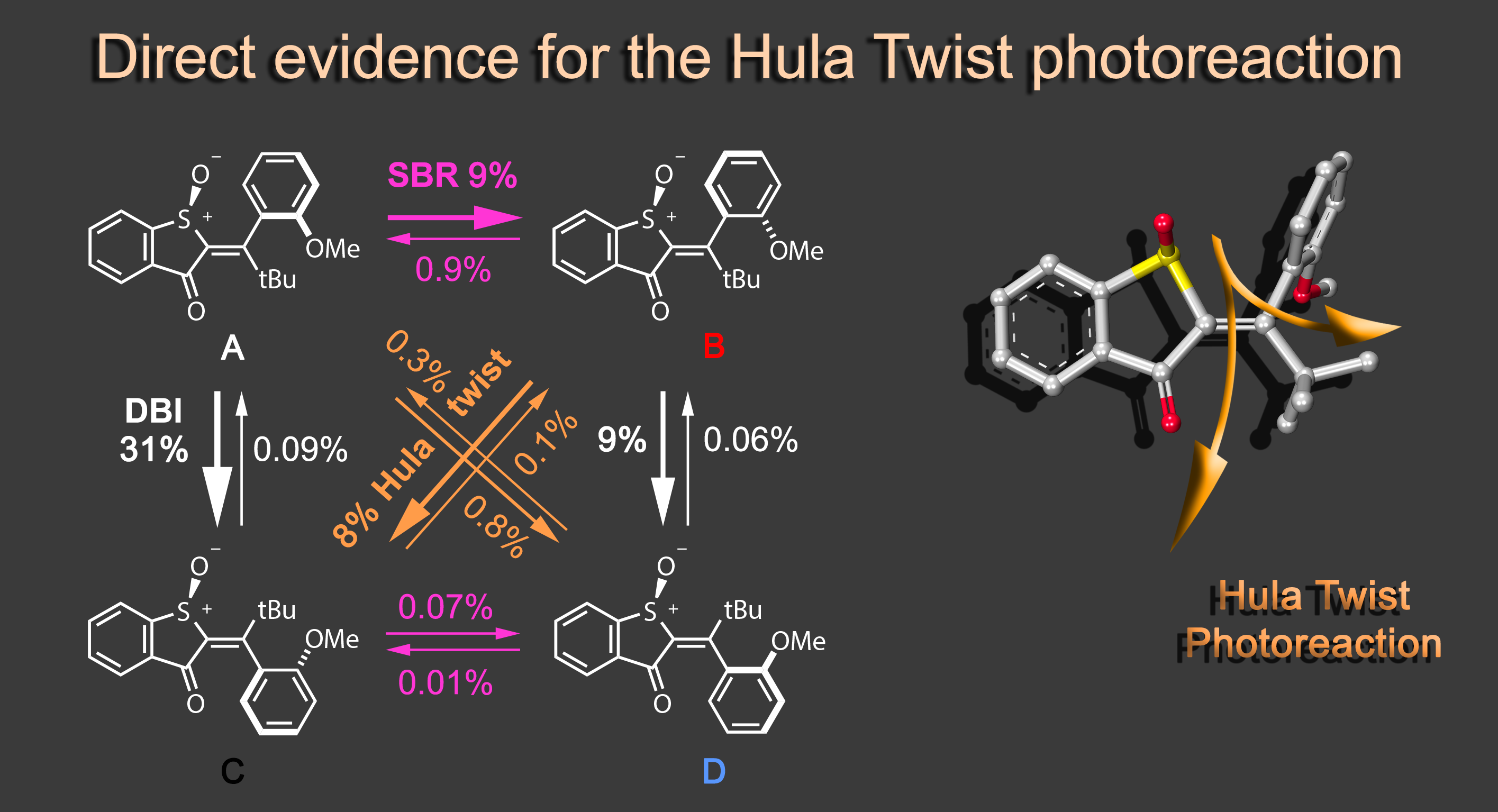
Focusing on the underexplored class of indigoid photoswitches1 we have established specific molecular designs, which allow us to evoke a range of distinctive bond rotations by irradiation and directly prove them experimentally. Using simple means, like solvent polarity or temperature, different types of such rotations can be interchanged within the same molecule providing exquisite control over multiple molecular motions. Examples are polarity dependent single or double-bond rotation in donor-substituted hemithioindigo2 or the long elusive hula twist, which we evidenced unambiguously in an axially chiral molecular setup.3 This hula twist photoreaction was subsequently studied in a combined effort including ultrafast spectroscopy and excited state theory to gain the first deep insights into its mechanism and the competition with other deexcitation pathways such as TICT formation.4
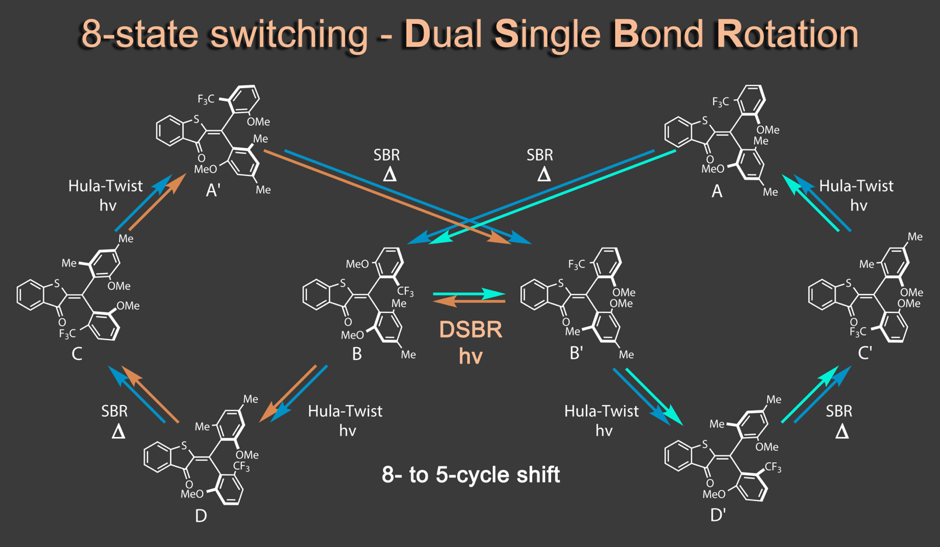
Recently we discovered a hitherto unknown photoreaction – a dual single bond rotation (DSBR) – in which two adjacent single bonds are rotating at the same time upon light irradiation. We use this photoreaction to control the sequential switching of a compact hemithioindigo multi-photoswitch to interchange between a highly selective eight-fold isomer interconversion and a five-fold interconversion. In the different switching sequences hula twist or DSBR photoreactions are followed by thermal single bond rotations (SBR). With this new photoswitching concept an unprecedented density of accessible states and very high control over molecular motions within a simple molecular framework is demonstrated.5
Apart from providing unprecedented insights into fundamental photochemical mechanisms these molecular systems possess especially high potential for the construction of unique future nanomachinery.
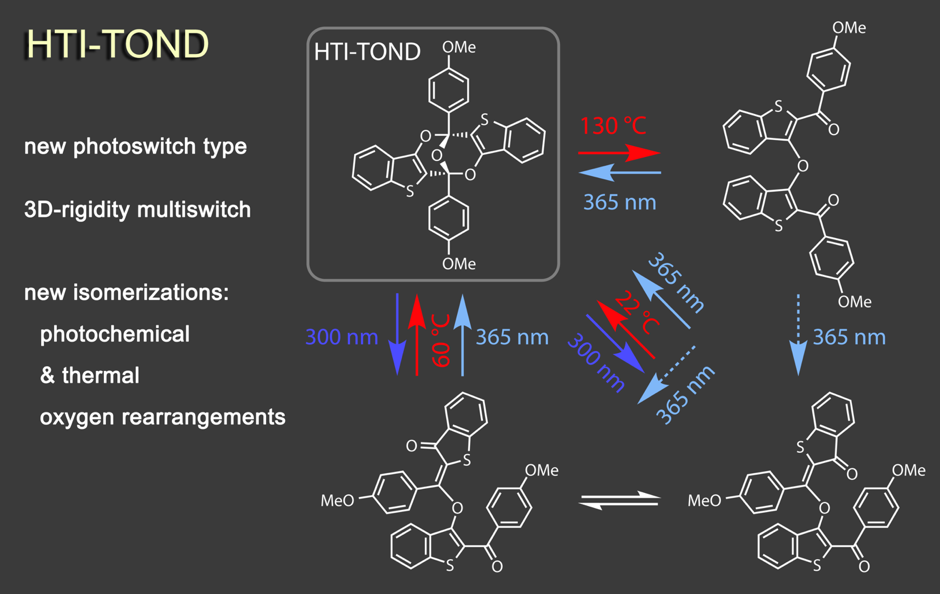
A suite of unique photochemical reactions is found within the trioxobicyclononadiene (TOND) architecture, which we have discovered to be a capable multi-state photoswitch.6 This rigid 3-dimensional structure interconverts with three additional isomers by unusual hetero-Diels Alder photoreactions as well as by hitherto unknown oxygen-rearrangement reactions. TOND photoswitches offer a rare combination of concomitant strong geometric and electronic changes upon switching and an intrinsic four-state nature. They thus provide unique opportunities for the creation of light responsive molecular systems and their applications.
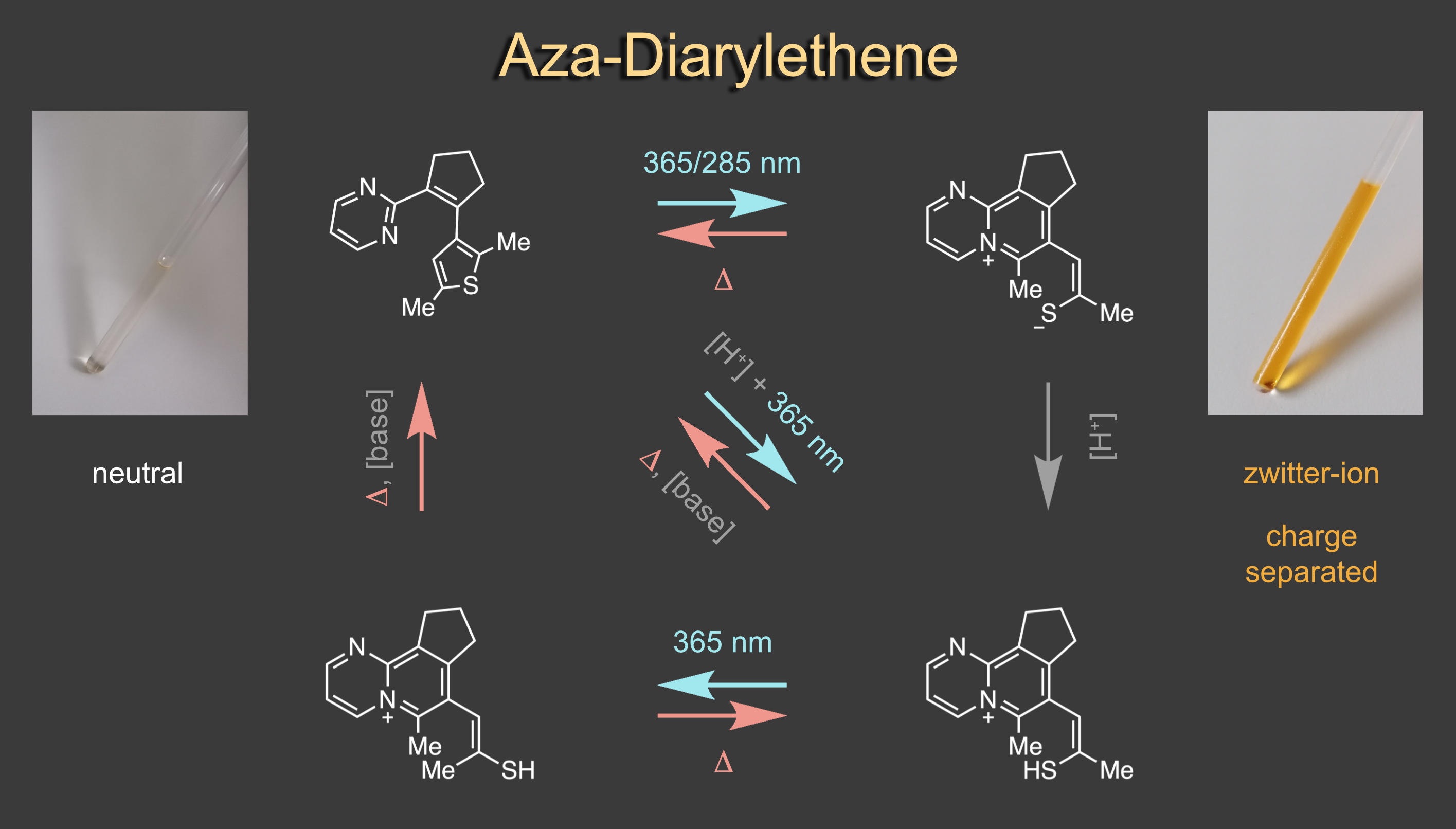
Apart from indigoid chromophores we also scrutinise other types of photoresponsive molecular frameworks. When investigating an aza-diarylethene derivative we discovered a reversible light induced zwitterion formation and concomitant aromatization reaction.7 The zwitterionic product shows negative solvatochromism and reverts completely back to the open aza-diarylethene in a thermally activated process. Thermal stability of the metastable state can be strongly modulated by acid and base additions, allowing to change the T-type photochromism deliberately. With this behaviour aza-diarylethene bridges the behaviours of diarylethenes and merocyanine photoswitches and provides unique photochemical control over charge separation and molecular structure.