
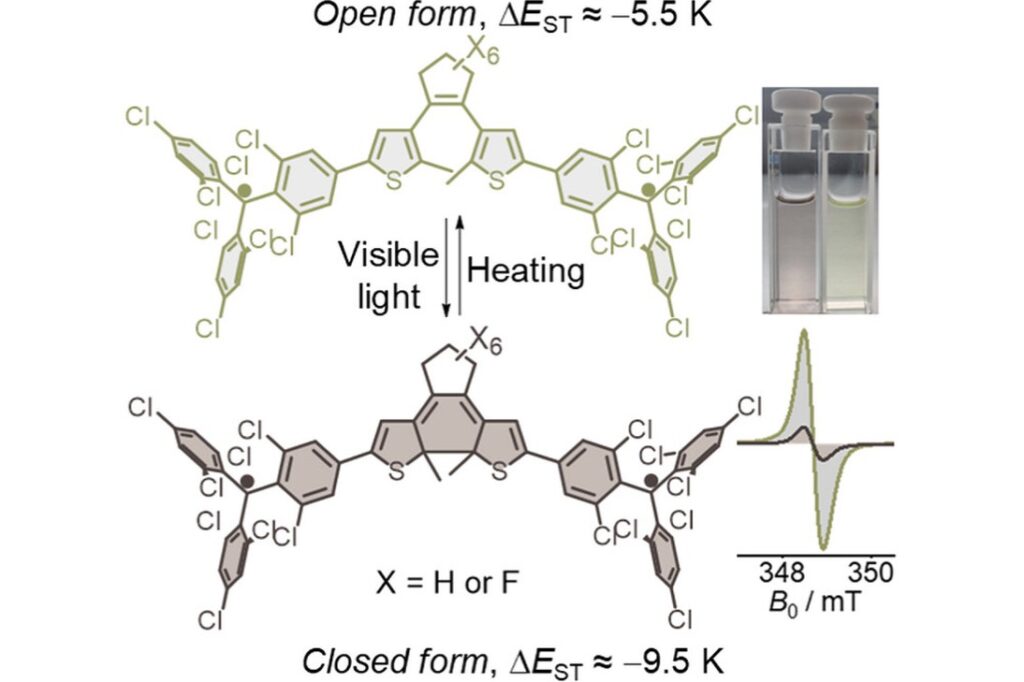
The Guldi Group published a new collaborative research article in Angewandte Chemie International Edition. We report a molecular system in which π-conjugation and with it, spin communication, between two radical centers can be reversibly switched on and off using light or heat.
To achieve this, two dithienylethene (DTE) photoswitches were incorporated into diradicaloids based on the TTM radical scaffold. This design allows the electronic connection between the two radical centers to be reversibly modulated through light or thermal input. Upon irradiation with visible light, the molecule’s open form converts to its closed form with up to 97% efficiency, changing color as well as its electrochemical and magnetic properties, since in the closed form, π-conjugation is established between the two radical centers.
To understand how this switching proceeds on a molecular level, we used femtosecond transient absorption spectroscopy. One of the molecules herby showed very peculiar behavior, in that switching from open to closed form is driven by light, whereas the reverse, closed-to-open switching, is not accessible via light and instead proceeds only thermally.
Together, these two bistable diradicals enable fast, reversible switching between open and closed forms via light and heat. The observed distinct and switchable optical, electrochemical, and EPR behavior renders DTE linkers a promising tool for designing tunable molecular spin systems, offering a way to externally control magnetic coupling for potential use in quantum technologies.
Find the article here: https://doi.org/10.1002/anie.5705848