
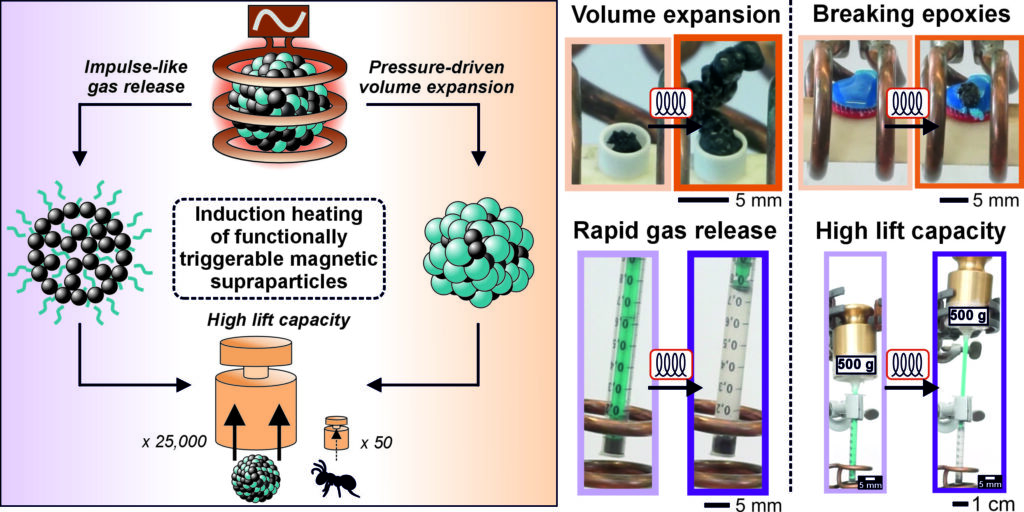
FAU researchers demonstrate how magnetic nanoparticles can convert heat into targeted mechanical forces – lifting up to 25,000 times their own weight.
Magnetic nanoparticles can generate heat remotely, without direct contact. Researchers at the Chair of Particle-Based Materials Chemistry at Friedrich-Alexander-Universität Erlangen-Nürnberg (FAU), in collaboration with the University of Helsinki, have developed a particle system that directly converts this heat into mechanical work. The micrometer-sized supraparticles expand when exposed to an alternating magnetic field, generating substantial forces.
From Heat to Mechanical Work
When exposed to an alternating magnetic field, magnetic nanoparticles convert electromagnetic energy into heat. This principle is being investigated for applications such as self-healing materials and the targeted debonding of adhesive joints.
The team led by Prof. Karl Mandel combines the nanoparticles with materials that expand significantly when heated. Spray drying produces micrometer-sized supraparticles in which the magnetic nanoparticles act as localized heat sources. The resulting heat triggers expansion, generating mechanical work.
Two Approaches to Expansion
The researchers developed two systems. The first uses azodicarbonamide (ADCA), which releases gas when heated, generating pressure inside the particle. The second is based on a superabsorbent polymer that absorbs water. When heated, the bound water evaporates, increasing the particle’s volume.
Both systems respond within seconds, with activation taking no more than five seconds.
Lifting 500 Grams with 20 Milligrams
The experiments demonstrate the system’s impressive capabilities: just 20 milligrams of material lifted a mass of up to 500 grams – 25,000 times its own weight. Heat is generated directly inside the supraparticles, creating high internal pressure that drives their expansion.
A key advantage is remote, contactless activation: no electrical connections or direct heat source are required. An external alternating magnetic field is sufficient.
New Opportunities for Materials Recycling
Potential applications include the targeted separation of material composites and adhesive joints. The researchers integrated the supraparticles into an epoxy resin matrix. As the particles expand, they generate localized mechanical stresses that can disrupt stable material structures. This approach could enable composite materials to be selectively separated, making them easier to reuse or recycle.
“With this approach, we bring the heat source and actuator together in an extremely small space. An alternating magnetic field supplies the energy, the magnetic nanoparticles convert it into heat, and an integrated functional component ultimately transforms that heat into pressure and motion. This could allow us to selectively separate individual components within hierarchical material structures,” says first author Leoni Luthardt.
The study, “Inductively Expandable Supraparticles as Microscopic Force Generators for Remote Mechanical Actuation,” by Leoni Luthardt, Stephan Müssig, Robert Luxenhofer, and Karl Mandel was published in Advanced Materials on September 15, 2026.
Contact
Prof. Dr. Karl Mandel
Chair of Particle-Based Materials Chemistry