
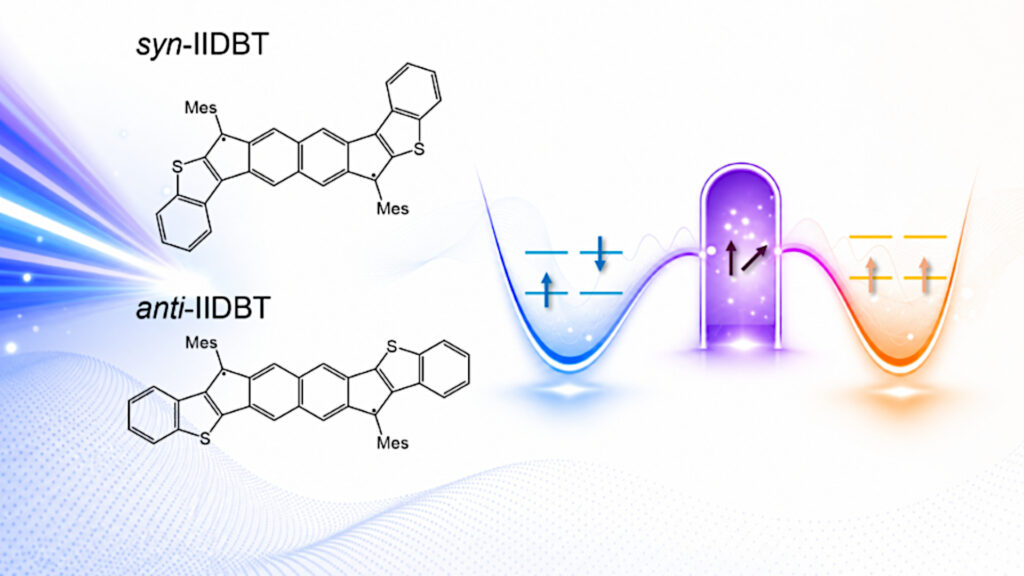
Researchers from the Department of Chemistry and Pharmacy at Friedrich-Alexander-Universität Erlangen-Nürnberg (FAU), led by Prof. Dr. Dirk M. Guldi, together with collaborators from the Haley and Lu research groups, have published a new study in the Journal of the American Chemical Society (JACS). The work provides fundamental insights into the interplay between molecular structure, nuclear motion, and excited-state spin dynamics in organic open-shell systems, advancing our understanding of photoinduced processes relevant to future molecular electronic technologies.
Spin-Vibronic Coupling in Indenoindenodibenzothiophene Diradicaloids
The article “Spin-Vibronic Coupling in Indenoindenodibenzothiophene Diradicaloids”, recently published in the Journal of the American Chemical Society, reports how molecular motion can control light-induced spin conversion in organic open-shell systems. The study was carried out through a collaboration between the Guldi, Haley, and Lu groups, focusing on indenoindenodibenzothiophene (IIDBT) diradicaloids, a class of organic molecules with unusual electronic structures.
When these molecules absorb light, their electrons are promoted into excited states. This excitation, however, is not purely electronic: the molecular framework also responds through bond stretching, ring deformation, and collective vibrational motion. The study demonstrates that specific vibrational modes can couple electronic and spin degrees of freedom, thereby enabling the excited molecule to change its spin state. This process, known as spin-vibronic coupling, provides a previously underappreciated pathway for controlling excited-state dynamics.
By comparing two closely related isomers, syn-IIDBT and anti-IIDBT, the researchers showed that subtle structural differences can substantially influence the efficiency of light-induced spin conversion. These findings reveal the critical role of molecular vibrations in open-shell organic materials and establish valuable design principles for next-generation optoelectronic and molecular spintronic systems. In particular, the work demonstrates how excited-state molecular vibrations facilitate spin-vibronic coupling and promote conversion from singlet to triplet character.
The publication is available in the Journal of the American Chemical Society:
Spin-Vibronic Coupling in Indenoindenodibenzothiophene Diradicaloids
DOI: https://doi.org/10.1021/jacs.6c03953
Contact
Prof. Dr. Dirk Michael Guldi
Chair of Physical Chemistry I
Professors