
Molecular Science (M.Sc.)
The Master degree programs in Molecular Science is an advanced research focused study programs, which run over 4 semesters (two years).
Students in Molecular Science (M.Sc.) may specialize in one of two exciting fields of modern, strongly interdisciplinary molecule-based research areas:
- Molecular Life Science focuses on the field of drug design based on modern findings in biochemistry, computational chemistry, genetics, medicinal chemistry, molecular biology, and organic chemistry.
or - Molecular Nanoscience focuses on modern nanoanalytics, the synthesis of inorganic and organic molecules, structure-property relationships, targeted functionalization, and the use of nanoscale objects in modern applications.
Students attend their core modules Molecular Lifescience or Molecular Nanoscience and add one compulsory elective module from a list of available interdisciplinary topics. For the Elective modules students are encouraged to choose courses according to their own preferences from chemistry or other science disciplines. Alternatively, language courses, law, and business studies may be considered.
A research module and the Master’s thesis gives the students a chance to develop a deeper understanding in a modern scientific topic of their choice.
Applications are possible for the summer and winter terms, starting in April and October. However, for Molecular Life Science program, we strongly recommend starting in the winter semester. This offers the best conditions for a good start to your studies.
General information and helpful links
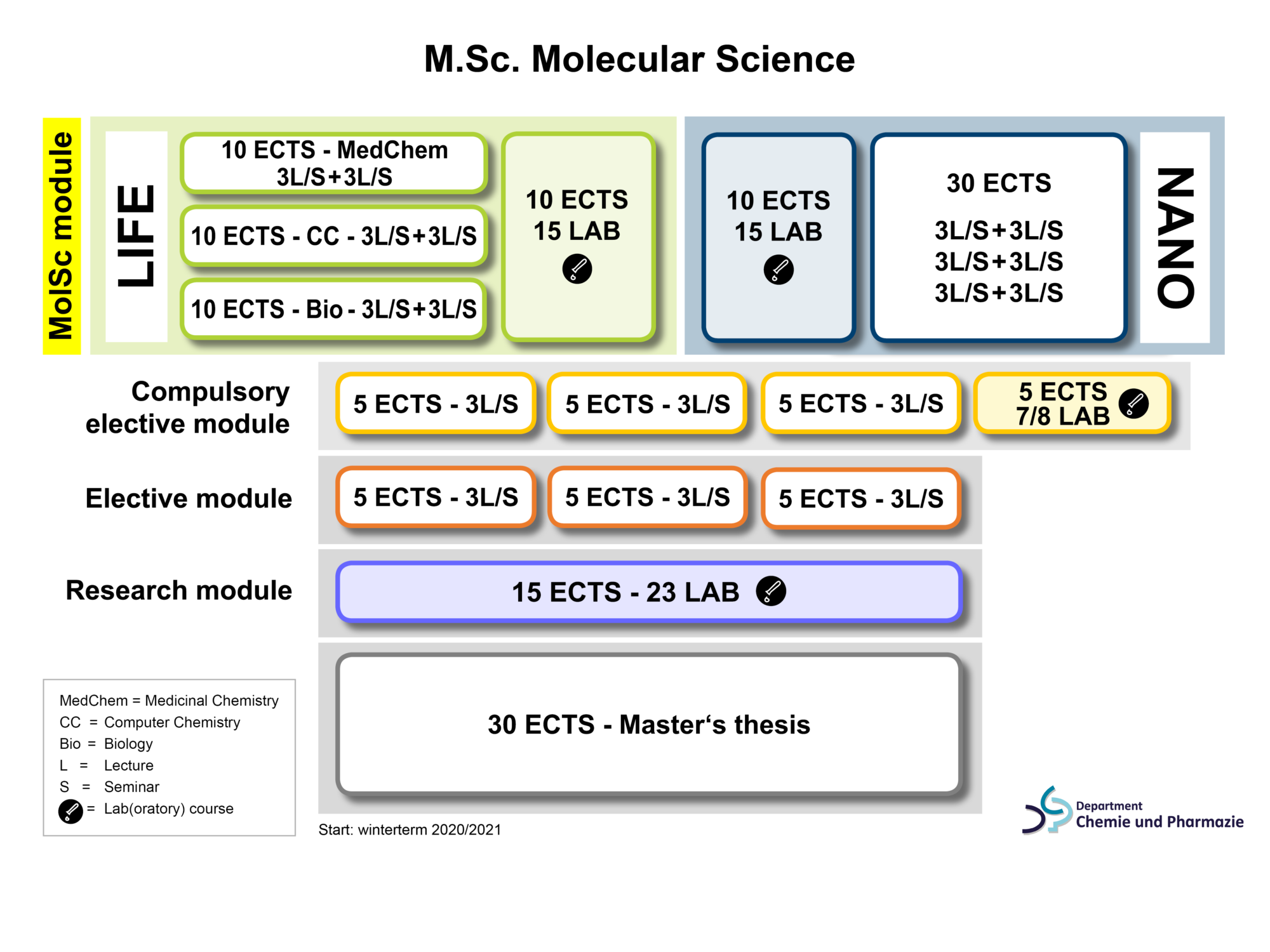
MSc Molecular Science degree program consists of
- Molecular Science core module (40 ECTS): choose either Molecular Life Science or Molecular Nanoscience
- each module includes 30 ECTS course work and 10 ECTS Lab practicals
- Compulsory elective module (20 ECTS): choose one out of the list according your choice of core module, each module consists of four thematically linked modules (5 ECTS each), with three modules course work and one module practical laboratory skills
- For Molecular Life Science
- Advances in Bio-Organic and Bio-Inorganic Chemistry
- Advances in Organic Chemistry
- For Molecular Nano Science
- Advances in Bio-Organic and Bio-Inorganic Chemistry
- Advances in Homogenous Catalysis
- Advances in Interface Research and Catalysis
- Advances in Energy Materials
- Advances in Organic Chemistry
- For Molecular Life Science
- Elective modules (3 x 5 ECTS): three modules (each 5 ECTS) specialist or non-specialist have to be chosen, which may include, e.g., language courses, key skills, science courses, or others (list tba online in Campo)
- Important for language courses!
A placement test has to be done before booking a language course.
Please contact the language center for details and information https://sz.fau.eu
- Important for language courses!
- Research module (15 ECTS): 8 weeks full-time lab project plus seminar in Inorganic Chemistry, Materials Chemistry, Organic Chemistry, Physical Chemistry, Quantum Chemistry, Medicinal Chemistry, Food Science, or the disciplines of biology involved in teaching
- Master’s thesis (30 ECTS): 6 months research project including writing of the thesis
Together, all modules add up to 120 credit points.
Lab course are a key component in our master’s programs – therefore a strong knowledge in the various fields of chemical lab work is required for the application. Please find the details on the extend of lab courses in the description of the respective study program.
Lab insurance
Every student who participates in a lab course in our study programs is required to have current and valid laboratory insurance before starting the course.
The lab insurance can be purchased online via http://www.laborversicherung.de/
The lab insurance is valid for all lab courses, and for one semester at a time.
Safety rules in a chemistry lab
The usual safety regulations governing laboratory coursework apply to our chemical laboratories as well; these regulations especially concern wearing safety goggles, overalls, and protective gloves; additionally, it is forbidden to eat, drink, or smoke in the laboratory areas.
Detailed safety instructions are available both in the laboratory and as a handout. Students are required to familiarize themselves with the theoretical basics of residual reactions prior to each experiment. Any equipment used in an experiment must be thoroughly checked beforehand.
Assistants are responsible for ensuring adherence to laboratory safety procedures and have the authority to undertake sanctions if necessary, such as excluding disruptive students from the lab. Assistants are also expected to know and keep record of any potential risks and the relevant safety regulations of any chemicals used in the experiments as well as their products.
Chemicals and glassware need to be handled carefully to ensure a safe environment for other assistants and students using the laboratories. Damaged glassware is to be immediately fixed or disposed of, and chemicals that emit toxic vapors are only to be handled under a fume hood.
Failure to adhere to safety regulations will result in consequences, and can lead to temporary or permanent exclusion from the laboratory course.
All experiments done in the laboratory must be documented in a lab notebook. Experiment reports require documentation of both reaction equations and reaction mechanisms. Reaction equations, reaction mechanisms, and description of the chemicals involved are to be recorded prior to execution of the experiment.
The Master’s thesis, worth 30 credit points, is part of the Master’s examination in Molecular Science.
Students should be able to independently investigate a subject-related problem by applying scientific research methods within a six-month time frame.
To avoid unnecessarily extending the study period, students are advised to decide on a topic for their Master’s thesis and contact the supervising professor on time. The master’s thesis is scheduled for the fourth semester. Before starting the thesis all module except the elective modules must have been passed.
Before starting work on their thesis, students are required to submit a registration form to Mrs. Petra Schmitt (Prüfungsamt / Examination Office) and to the Student Service Center (SSC) via Email. An extension of the processing time is only possible by submitting a timely and justified application to the responsible examination board.
The Master’s thesis may be supervised by all Professors and habilitated lecturers in the Department of Chemistry and Pharmacy. The following requirements must be met:
the first supervisor (reviewer) belongs to the Department of Chemistry and Pharmacy or university lecturer or is a professort or habilitated lecturer of the Department Biology who teaches in the MSc Molecular Science program.
the second supervisor (-reviewer) either belongs to the Department of Chemistry or Pharmacy or is external (external Master’s thesis) both are habilitated and/or professors.
In exceptional cases, an application for an external Master’s thesis can be submitted (please contact the Examinations Office).
When submitting their thesis, students are required to provide two identical copies, printed and bound, as well as en electronic version on a USB stick or similar storage device to the Examinations Office (Prüfungsamt). If the thesis is not handed in by the deadline, it will unfortunately be considered rejected and given a mark of 5,0 or “insufficient.”
The maximum time frame for your Master’s thesis is six months (handing in the final version at the examination office).
The master thesis research may also be conducted externally, the decision on this matter is made by the chair of the examination board.
Tentative Time frame for the Evaluation of the Master’s Thesis
Students must submit their Master’s thesis by the deadline to Mrs. Schmitt in the Examinations Office (Prüfungsamt).
The Examinations Office will notify your thesis supervisor of the date of submission. The thesis will then be evaluated by your supervisor and a second examiner.
The Master’s thesis should be evaluated within one month.
If your thesis is not graded within one month, please check directly with the supervisor.
Title Page of the Master’s Thesis
The title page must include the title and student’s name, and the second page must include a signed declaration of independent authorship. Please refer to this sample template.
For more detailed information on the legal implications of submitting your Master’s thesis, please see the examination regulations (Prüfungsordnungen)
If you need help writing a paper, report, or an application, please seek out support from the Writing Centre.
- Registration periods for module examinations can be found on
Examinations Office – Faculty of Sciences › Friedrich-Alexander-Universität Erlangen-Nürnberg (fau.eu)
Students must register for these examinations via campo. - Core Modules:
- Molecular Life Science written exams in the lecture free time of the term
- Molecular Nano Science: according consultation with the coordinator/lecturers
- Compulsory elective/elective modules: oral or written exams at the end of the lecture period of the term (details announced by the teaching professor or the module coordinator)
- Research module (8 weeks fulltime): graded laboratory report plus raw data documentation, to be delivered within 8 weeks of all raw data being available
- Master’s thesis: 6 months, registration via registration form (Note: Exams and lab practicals in the core & compulsory elective modules and the research module must have been passed before starting the master’s thesis)
The examination regulations (Prüfungsordnung) govern the examinations in the Master’s degree program in Molecular Science.
The module guide provides information as to the content, extent, aims, and prerequisites of the modules mentioned in the program and examination regulations, as well as the names of lecturers and their respective module coordinators. The module descriptions are available via Campo.
You can also find the module guide here (please note: module guides from Campo will only show the courses of the current semester!):
- MSc Molecular Science (PO 2020) – Summer term 2026
- MSc Molecular Science (PO 2020) – Winter term 2025/26
- MSc Molecular Science (PO 2020) – Summer term 2025
- MSc Molecular Science (PO 2020) – Winter term 2024/25
- MSc Molecular Science (PO 2020) – Summer term 2024
- MSc Molecular Science (PO 2020) – Winter term 2023/24
Schedule MSc Chemistry & Molecular Science (winter term 2025/26 and summer term 2026)
Further information on modules and courses can also be found in Campo. All information on courses is preliminary.
Relevant Academic background
The successful completion of a Bachelor’s degree in a relevant subject is required for admission to both Master’s degree programs, Chemistry and Molecular Science. Since these programs build upon the basic concepts generally learned in a Bachelor’s program, the required first degree must be closely related.
Relevant academic background for applicants for M.Sc. Molecular Science
A Bachelor’s degree Chemistry or Molecular Science at the FAU is considered directly relevant. Applicants with closely related degrees may also be eligible if their studies included at least 60% in general and inorganic chemistry, biochemistry, material chemistry, organic chemistry, physical chemistry and theoretical/computer chemistry. A minimum of 25% of the above-mentioned subjects have to be covered by sound, independently acquired laboratory knowledge as documented by relevant entries in the lab journal.
For the Molecular Life Science track an additional minimum of 20% in Molecular Science and or Medicinal Chemistry including at least 5 ECTS in mathematics or mathematical methods is required.
For the Molecular Nano Science track an additional minimum of 20% in material chemistry and microscopic methods including at least 5 ECTS in mathematics or mathematical methods is required.
A grade of 2.5 or better according to the German grading system has to be proved in the qualifying Bachelor’s program.
Students who have not yet completed their Bachelor’s degree must have completed the equivalent of at least 135 ECTS (approximately 75% of a standard Bachelor’s program) at the time of application.
Laboratory journals of independently conducted laboratory experiments (excluding Bachelor’s thesis) as well as an additional summary list of the same in the scope of 1-2 pages (module descriptions are not accepted) must be enclosed with the application.
English language requirements
Applicants must provide proof of English language proficiency at CEFR level B2 (or equivalent). This requirement is waived if the previous degree was completed entirely in English.
Additional Requirements for International Applicants
Applicants whose nationality does not fall under the Lisbon Recognition Convention may be required to meet additional formal criteria.
In particular:
- The Bachelor’s degree must have been obtained from a university listed as H+ in the Anabin database.
- Applicants must submit results from a standardized subject-specific test:
- the GRE (Graduate Record Examination) Subject Test in Physics, with FAU specified as a designated recipient, and a minimum score at the 50th percentile, or
- the GATE test in Chemistry (e.g. for applicants from India), reaching a minimum score of 650, or
- the GAT test certificate (Pakistan), minimum score at 65th percentile
- or a comparable standardized entrance test result for international Master’s programs
Application
All applications must be submitted online via CAMPO, the FAU’s application portal.
Read more: Applications and admissions
The biannual application deadlines are…
- July 15th for the upcoming winter term
- January 15th for the upcoming summer term
We strongly recommend for non-EU students to apply as early as possible to get an early decision to apply for a visa in time – latest by May 15th!
Please keep in mind the main start is the winter term, some modules might be easier to study when starting in the winter term.
Selection Procedure
Admission is based on academic performance and subject-specific background. Depending on qualifications and grades, applicants may be invited to an oral interview conducted in English.
The interview assesses:
- Subject and methodical knowledge in the fundamentals of chemistry (80%)
- Chosen focus areas in the field of chemistry/molecular sciences (20%)
The final admission decision is made by the program’s admission committee.
You need more information for a successfull study start at the FAU?
Please check out Starting out at university | FAU.
Teaching language is English (English knowledge has to be proven with the admission), however some courses might be offered in German only (e.g. elective courses).
Graduates of the Master’s program in Molecular Science at (FAU) benefit from interdisciplinary training at the interface of chemistry, physics, biology, and materials science.
The Molecular Life Science specialization prepares students for careers in pharmaceutical and biotechnology companies, particularly in drug discovery and development, molecular modeling, and for doctoral studies in life sciences or medicinal chemistry, as well as for positions in regulatory science, scientific consulting, and biomedical research institutions. Graduates are particularly qualified for research-driven environments where molecular approaches are central to solving biomedical challenges.
The Molecular Nano Science specialization opens career paths in nanotechnology, advanced materials developement, semiconductor and energy industries, as well as in high-tech research and development. They are also excellently prepared for doctoral studies e.g. in nanoscience or materials science, as well as for innovation-driven roles in emerging fields such as quantum technologies and sustainable functional materials.
Both tracks provide strong preparation for international careers in academia, industry, and science-based leadership positions.