
Index
Research
CPC GroupIn the Computational PhotoChemistry (CPC) group, we explore the fascinating world of light-induced molecular phenomena. By integrating quantum chemistry, chemoinformatics, and spectroscopic data, we uncover the principles driving photochemical and photophysical processes at the molecular level.

Research Areas
Mechanistic Studies of Photoactive Molecules
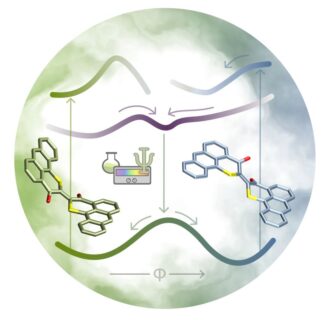
Our group investigates the fundamental mechanisms that govern how photoactive molecules convert light into motion, charge, or chemical reactivity. Using excited-state quantum chemical simulations and photodynamics simulations, we uncover how structural features, key geometries (e.g. minima, transition states and conical intersections), and spin states shape photophysical properties and photochemical reactions. These insights guide the rational design of molecular photoswitches and photocatalysts with tailored performance.

Data Infrastructure & Machine Learning for Excited-State Dynamics
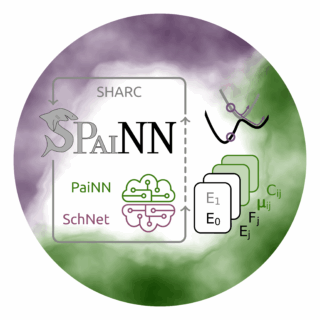
We are developing tools to support the lifecycle of excited-state dynamics data, beginning once trajectories are available. We aim to enable exploratory analysis, visualization, and the extraction of mechanistic insights, while standardizing how simulation data are stored and applied in machine learning workflows. By bridging raw trajectory data with AI models and community data standards, we aim to facilitate reproducible, large-scale, and accelerated simulations of photoactive systems, providing researchers with streamlined tools to efficiently turn data into understanding.

Molecular Design and Functional Photoactive Materials
Building on mechanistic and computational insights, we design and predict new classes of functional photoactive molecules. Our work combines quantum chemistry and digital chemistry approaches to discover fluorophores and chromophores with optimized photophysical properties — from always-on fluorescence to digitally predicted absorption properties.
Research Spotlights

Excited-state phenomena: Unraveling structure-property relationships across dimensions
(Third Party Funds Group – Sub project)Overall project: SFB 1719: Next-generation printed semiconductors: Atomic-level engineering via molecular surface chemistry
Project leader:
Term: 1. October 2025 - 30. June 2029
Acronym: SFB 1719 M02
Funding source: DFG / Sonderforschungsbereich (SFB)Project M2 is devoted to the development and application of approaches to elucidate and predict excited state phenomena in aggregates of varying numbers of atoms and molecules. This includes studying model systems throughout the molecular precursor-to-material pathway, from individual atoms and molecules to aggregates and extended systems such as two-dimensional (2D) materials on different length-scales (e.g., monolayers or multilayers), assembled molecules (e.g., dimers or monolayers), and molecules adsorbed or covalently bonded on surfaces. The primary focus will be on transition metal dichalcogenides, V-VI chalcogenides, and perovskites for materials, and photoswitches for molecular systems. To address this challenge, we will use a combination of ab initio quantum chemical methods, such as time-dependent density functional theory and many-body perturbation theory, along with data science techniques. This approach will help us to explore structure- and size-dependent properties of excited state phenomena, including electronic absorption and emission spectra and the yield and rate of certain photoinduced processes. The developed procedures will be critically validated through close collaboration with experimental spectroscopic projects, reinforcing our understanding of how certain structures determine the excited state properties of materials.
Navigating the Odyssey of Photochemistry: Charting Efficient Strategies for the Prediction and Optimization of Light-Induced Triplet Energy Transfer Reactions
(Third Party Funds Single)Project leader:
Term: 1. February 2025 - 31. January 2031
Acronym: HRCD 2024
Funding source: Stiftungen
URL: https://hector-fellow-academy.de/spitzenforschung/hector-rcd-awardees/carolin-mueller/PRISM: Photochemical Rules and Insights for Systematic Modeling
(FAU Funds)Project leader:
Term: 1. December 2024 - 31. December 2025
Acronym: EAM-SG24-01Eco-PhotoCompute - Crafting Sustainable Strategies for Computational Photochemistry
(FAU Funds)Project leader:
Term: 15. July 2024 - 15. July 2025
Acronym: ETI-Förderung 2024-2_Nat_09_Mueller