
FAU Researchers Elucidate the Mechanism of a Novel Red-Light-Activated Molecular Photoswitch
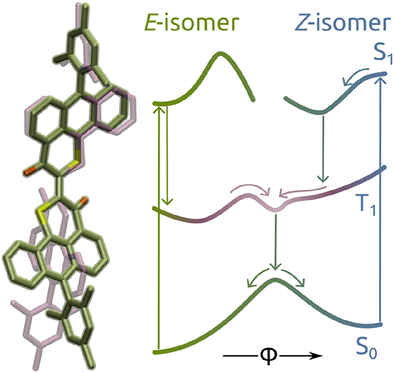
Researchers at Friedrich-Alexander-Universität Erlangen-Nürnberg (FAU) have successfully elucidated the mechanism underlying the light-induced isomerization of a novel molecular photoswitch. Their findings provide a fundamental basis for the development of materials that can be precisely controlled using particularly low-energy light, specifically in the red to near-infrared spectral range. This breakthrough opens up new perspectives for applications in photomedicine, sensing technologies, and the design of molecular machines. The study has been published in Angewandte Chemie International Edition.
The investigated molecule, peri-anthracenethioindigo (PAT), represents a highly unusual photoswitch. In contrast to conventional photoswitches, which typically respond to high-energy blue or ultraviolet light, PAT can be activated by red and even near-infrared light. Until now, however, the pathway by which PAT changes its conformation—known as E/Z isomerization—had remained unclear. To resolve this question, the research team combined state-of-the-art femtosecond laser spectroscopy with advanced quantum-chemical simulations, enabling them to observe, for the first time, the real-time structural dynamics of PAT following photoexcitation.
Their experiments revealed that, upon light absorption, the molecule transiently populates a so-called triplet state. Only in this excited state is PAT able to undergo a complete rotation about its central double bond, thereby switching its molecular configuration. In this way, the molecule effectively operates as a nanoscale rotary switch. Notably, this photoinduced transformation remains stable even in the presence of oxygen, a feature that distinguishes PAT from many existing photoswitch systems.
These insights not only deepen our understanding of the photochemistry of thioindigo-based compounds but also demonstrate how rational molecular design can yield highly efficient, red-light-responsive photoswitches that are robust under ambient conditions. The knowledge gained from this work lays the foundation for the development of next-generation compounds, accelerating progress toward biocompatible photoswitches, photoactive materials, and molecular data storage systems.
*https://doi.org/10.1002/anie.202510626