
Enzyme-inspired single-atom photocatalysis for oxygen reduction to hydrogen peroxide
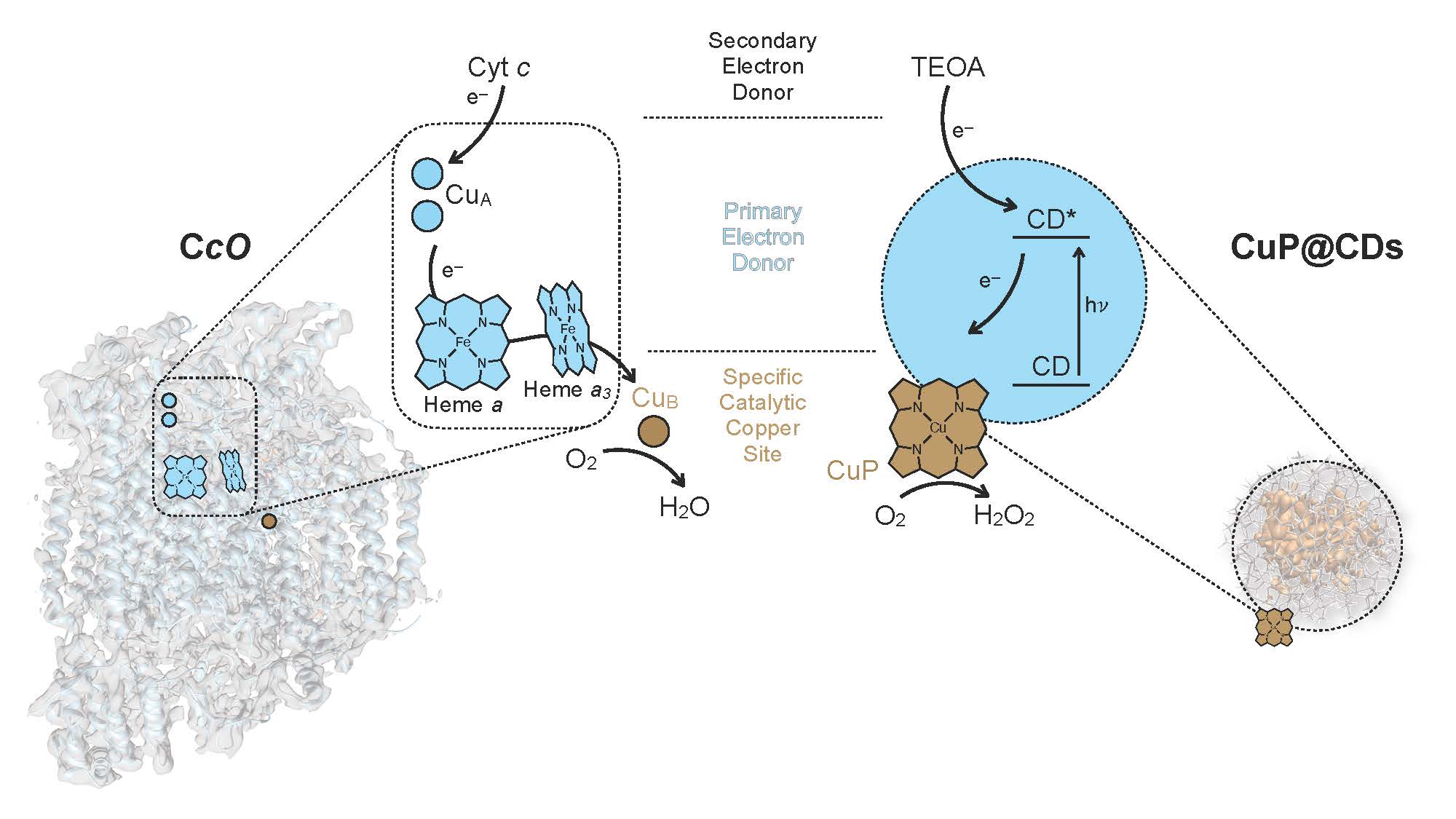
This article, recently published in Nature Communications, presents a breakthrough approach to light-driven catalysis by translating enzymatic precision into artificial photocatalysts. The study was carried out by an international team from the Friedrich-Alexander-Universität Erlangen–Nürnberg (FAU), the VSB – Technical University of Ostrava (VSB-TUO), Palacký University Olomouc (UPOL), and the University of Buenos Aires (UBA).
In this work, the researchers developed single-atom-engineered carbon dots inspired by the structure and function of cytochrome c oxidase, the terminal enzyme of cellular respiration. By integrating individual copper atoms into porphyrin-like domains of carbon dots, the team created a photocatalyst capable of selectively reducing molecular oxygen to hydrogen peroxide, a key chemical for clean energy, environmental remediation, and sustainable industrial oxidation processes.
“Traditional photocatalysts often lack the selectivity and efficiency of enzymes,” said Lukáš Zdražil, the first author of the study. “By mimicking the site-specific electron-transfer cascade of cytochrome c oxidase, we created a photocatalyst that channels electrons precisely to the active center, just like in nature. This results in a highly selective and efficient light-driven reaction.”
According to Dirk M. Guldi, a corresponding author from FAU Erlangen–Nürnberg, “This study opens a path toward biomimetic photocatalysts that unite the best of both worlds, the precision of enzymes and the robustness of solid-state materials.”
Edit:
In addition, we are pleased to announce that our article has been selected for the Editors’ Highlights webpage on Nature Communications, under the “Materials Science and Chemistry” section. This prestigious page features the top 50 recent papers in the field, with selections routinely updated as new exemplary research is published. You can view the highlights here: https://www.nature.com/ncomms/editorshighlights.
Further information
https://www.nature.com/articles/s41467-025-67189-3
Prof. Dr. Dirk Michael Guldi
Professors